For bathroom furniture importers and developers, the choice between Flat-Pack (KD) vs. Pre-Assembled Vanities is one of the most defining decisions in their supply chain. It’s a classic trade-off: Do you prioritize product stability or shipping density?
To help you choose the right format for your business model, in this blog, let’s take a closer look at how these two vanity styles are actually built and how that construction impacts your bottom line.
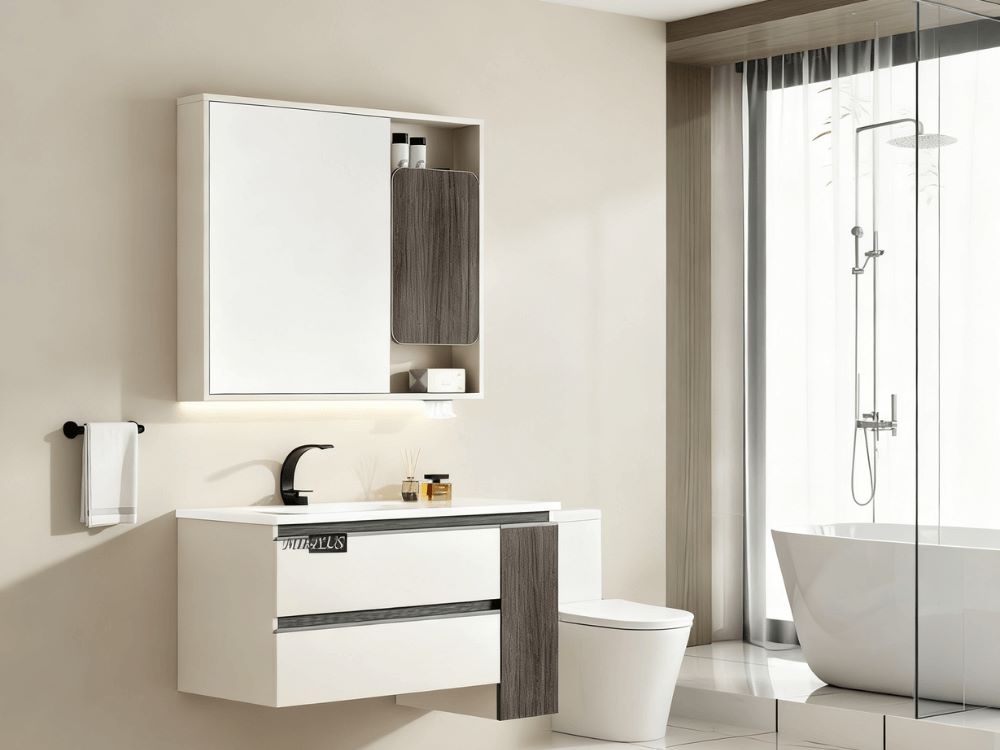
When we say “pre-assembled,” it means we've assembled everything for you, so you don't have to worry about putting it together. From countertops to sinks to drawers or cabinets—everything is integrated and ready to go.


Pros of Pre-assembled bathroom vanities:
Cons of Pre-assembled bathroom vanities:
Flat-Pack, or "Ready-to-Assemble" (RTA), is a format designed specifically to solve the problem of high freight costs. Flat-pack cabinets refer to kit-style cabinets typically shipped flat-packed in boxes. You receive all the panels, screws, and hardware needed for self-assembly or contractor installation.

Pros of Flat-pack(KD) bathroom vanities:
Cons of Flat-pack(KD) bathroom vanities:
It is important to weigh how these two formats fit your specific project constraints. Here is a quick comparison of the four factors that matter most to buyers.
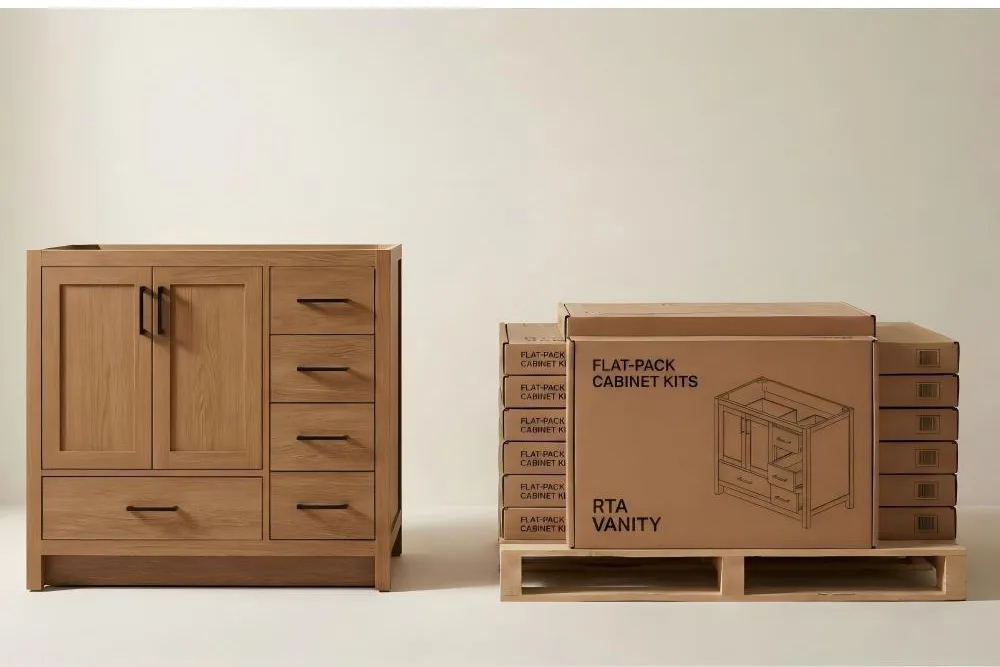
Quality and Durability
If long-term structural integrity is your top priority, Pre-Assembled cabinets are the clear winner. The factory-glued joints create a permanent, monolithic bond that resists humidity and vibration far better than mechanical fasteners.
Project Budget
When looking strictly at the "Factory Price" (FOB cost), RTA cabinets are always the more economical choice, because we do not have to pay our factory workers to assemble the unit. Pre-Assembled units carry a slightly higher price tag to cover the skilled labor and industrial glue required for construction.
Customization Options
Pre-Assembled construction allows for unlimited design freedom, including complex dovetail drawers and seamless "furniture-style" sides. RTA cabinets, by nature, must be simple enough to break down into flat panels. If your design requires intricate joinery or unique curves, factory assembly is usually the only viable option.
This is often the deal-breaker for large projects. Pre-Assembled vanities are "Plug-and-Play"—you simply unbox them and mount them to the wall in minutes. In contrast, RTA cabinets require a significant investment of time and "sweat equity" to sort the hardware and assemble the frame.
The "Hidden" Deciding Factor: Freight
While the factors above are crucial for the end-user, for an International Importer, the decision often comes down to one massive hidden cost that overrides everything else: Logistics.
If you were buying locally, you might choose based on installation speed alone. But when you are shipping containers across the ocean, you are paying for Volume, not just the product.
Consider the space inside a standard bathroom vanity. When you ship a Pre-Assembled unit, you are paying ocean freight rates to transport the empty air inside the drawer cavity and the cabinet body. In a time of fluctuating container prices, this inefficiency adds up quickly.
Let’s look at a standard 40HQ container load for a typical 750mm (30-inch) vanity model:
This means that by switching to Flat-Pack, you can fit roughly 2.5 to 3 times more inventory in a single shipment. If ocean freight represents a significant percentage of your product cost, choosing KD effectively slashes your "Per-Unit Shipping Cost" by nearly 60%, giving you a massive competitive advantage in price-sensitive markets.
However, freight is not the only cost. You must balance Shipping Savings against Labor Costs.
Imagine you are outfitting a hotel with 300 rooms. If you import KD units to save on freight, you are simply transferring the labor burden from our efficient factory line to your expensive job site.
If a local carpenter charges $50 per hour and takes 40 minutes to unbox, sort, and assemble a vanity, you have just added $33 in pure labor cost to every single unit.
In many Western markets, this local labor cost is actually higher than the money you saved on ocean freight. Furthermore, Pre-Assembled units are "Plug-and-Play"—they can be installed in minutes, keeping your construction schedule on track.
The equation changes completely if you are a distributor selling to homeowners or contractors. In this model, you do not pay for the assembly—your customer does.
You pocket the massive freight savings, and the end-user provides the "sweat equity" to build the cabinet. For e-commerce sellers and wholesale distributors, Flat-Pack is almost always the more profitable route because it maximizes your margin while minimizing your warehouse overhead.
As a manufacturer, we want your project to run smoothly. Here is our honest recommendation based on our client success stories:
| Your Business Type | Recommended Format | Why? |
| Hotel / Commercial Developer | Pre-Assembled | Risk Mitigation. You get guaranteed factory stability, zero site assembly labor, and faster installation speeds. |
| Luxury Showroom | Pre-Assembled | Quality Perception. Your clients expect a solid, seamless cabinet without visible assembly hardware. |
| Wholesaler / E-Commerce | Flat-Pack (KD) | Price Competitiveness. Maximize your container space and reduce your warehousing costs. |
To help you decide, here is how two recent Mirplus clients solved their specific challenges.
RTA Success Case: Take the example of our customer, Mark, a developer in California. He initially wanted flat-pack cabinets to save on shipping for his 150-room hotel. But with a tight deadline, he listened to our advice and switched to Pre-Assembled. Finally, his team installed 40 units a day, finishing the project three days early without hiring extra carpenters. The slightly higher freight cost saved him a fortune in labor and stress.
Pre-Assembled Success Case: Then there’s Carlos, a distributor in South America. He needed to beat a competitor’s rock-bottom price, so he chose Flat-Pack (KD) to maximize volume. By fitting more units in a container (instead of 200), his shipping cost dropped. He deals with the occasional assembly question, but that massive freight saving allows him to undercut everyone else in his market.
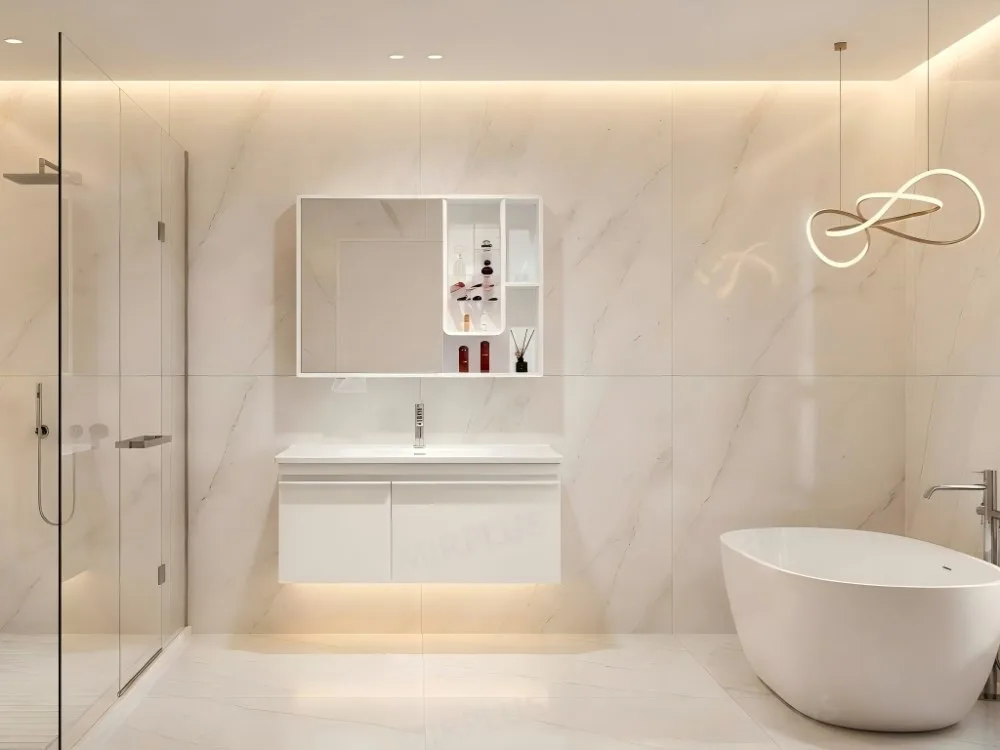
As you can see, the "best" choice depends entirely on who will eventually install the cabinet.
Let Us Build Your Perfect Solution
At Mirplus, we don't just sell cabinets; we help you optimize your supply chain. Whether you need the solid reliability of a factory-built vanity or the logistical efficiency of a flat-pack, we have the manufacturing power to deliver.
Q: Is a Flat-Pack cabinet actually as strong as a Pre-Assembled one?
A: While Flat-Pack units are sturdy when built correctly, Pre-Assembled cabinets offer superior long-term stability.
Q: Which style do you recommend for hotel or commercial projects?
A: We strongly recommend pre-assembled for hotels. In a commercial setting, installation speed and consistency are critical. Pre-Assembled units allow your contractors to install the vanity in minutes rather than hours, which helps keep your construction timeline on track and ensures every room looks identical.
Q: What is the actual difference in container loading capacity?
A: The difference is significant. You can typically fit about 2.5 to 3 times more inventory in a container when choosing Flat-Pack. For example, a 40HQ container might hold 220 assembled units, but over 550 flat-pack units. This density is the primary reason wholesalers choose the RTA format.

Copyright 2022 - All Mirplusbath